archive for the ‘yoga poses’ category

q+a: DEEP POWER

Tuesday, May 3rd, 2011

ever experience tightness or tension in your hips, hamstrings or shoulders?

yeah, us too…so, we cooked up a remedy: DEEP POWER. if you’re serious about getting stronger and more flexible, join us on tuesdays and thursdays from 7-8 p.m. — want to know more? keep reading.

    what exactly is DEEP POWER?
    a 60-minute POWER class with a focus on longer holds and deep opening for the hips, hamstrings, low back, neck and shoulders.


    will it be harder than a POWER class?
    not necessarily, like any of our classes, you’ll go at your own pace. the poses and holds will be intense, but nothing you won’t be able to handle. modifications will be offered and you’ll feel your flexibility and strength build with each class. if you’re stiff or not-so-flexible, this IS the class for you!


    will it be a slow class?
    not really. the flow will work at your breath pace…we will spend longer in each opening pose that we would in a regular FLOW or POWER class, but we will move at a pace that will keep you engaged and working.


    will the poses be the same?
    YES…you’ll recognize all of them! we’ll focus on the poses that concentrate on opening the hips, shoulders, hamstrings and low-back (think warriors, triangles, backbends, pigeons, frog, forward bends, splits, twists…oh my!), as well as spending some time upside down in poses like legs-up-the-wall, shoulderstand or (always optional) headstand.


    will there be heat?
    YES! the heat will help you relax more, deepen your poses and get your sweat on.


    do i need any special equipment for the class?
    nope. just bring your mat, your water bottle and a towel. when you get here, hook yourself up with two blocks, a blanket and a strap.


    will i feel it the next day?
    oh, indeed…and you’ll love it.

got more questions? give us a call or an email…or just show up at 7 and join the fun!

everybody put your feet in the air….

Thursday, April 14th, 2011

ahh…week 5 of 40 Days to Personal Revolution. RESTORATION. while it’s not all about relaxing — there’s some pretty heavy work that goes on in the self-excavation process — this week is an opportunity to remember the value in relaxation and restoration.

the idea is to slow down for a bit, so our bodies and minds to get sharper, faster and better when we’re working and playing. meditation, being in nature, playing and spending time doing anything that just makes us feel good can all be great ways to restore and renew ourselves. there are also specific yoga postures that can bring us into greater states of relaxation.

inversions are postures in which you position your heart above your head (and sometimes your feet above your heart). these poses improve circulation and respiration and hormonal balance…they basically help us cool down and tune in.

a great one to practice when you want to get really chill is Viparita Karani (which means inverted action)…there are lots of variations of this; here are a few from the simplest to the sweetest setup:

    neat…lie on the floor with your legs extended straight up.
    on the rocks…put a yoga block (better yet, two side by side) under your sacrum.
    the highball…slide over to a wall and rest with your legs supported by the wall. make sure you’re comfortable, this is a relaxing pose, not a stretching one…so let yourself slide away from the wall if you are feeling it too much in the hamstrings or low back.
    the nightcap…add a bolster or folded blankets under your sacrum and an eye pillow over your eyes. nighty-night…

these are great options to practice at home, or in class as an alternative to shoulderstand. experiment and see how they work for you…enjoy!

    for fast-acting relief, try slowing down
    lily tomlin

ground down, rise up.

Saturday, February 12th, 2011

week 5 of the forty days program is dedicated to centering and grounding…getting fully present, fully stable and fully sane. if any pose encompasses these principles, it’s the one we call our true north…Tadasana (Mountain Pose). it’s basically about standing on your own two feet, fully present in your body, strong and relaxed, centered and open.

when our teachers go to teacher training bootcamps, one of the fundamental things we learn is that Tadasana is found in every other pose we practice…a clear understanding of Tadasana leads to a better understanding of every pose in the practice. of course, the central point of any pose is deep, clear ujjayi breathing…but here’s a “toe-to-head” blueprint for building your true north:

    - ground the corners of your feet down into the floor.
    - pull the baby toe away from the big toe (spread out those piggies – no monkey toes).
    - spin your inner ankles back and your outer ankles down.
    - press your outer shinbones in, your calves forward
    - press your thighbones back and lift your kneecaps with your thigh muscles (no locked knees).
    - lift the front of your pelvis (uddiyana bandha) and drop your tailbone toward the floor.
    - keep your pelvis neutral, like it was a bowl of water filled to the brim and you don’t want to spill any.
    - draw your armbones back, scoop your shoulder blades down and forward.
    - draw your thoracic spine (the vertebrae that run through the ribcage) into your body.
    - expand and melt your chest, your upper back and heart center.
    - soften your face, set your drishti gaze and lift the crown of your head.

Tadasana can be practiced with the arms at the sides, or the arms overhead — as you reach your arms up, press into your feet more firmly and feel the rebound effect that creates length and space in your entire body.

play dead.

Saturday, February 5th, 2011

ahhhh, Savasana (Corpse Pose). the perfect pose to end Week 4…or any week.

the final pose of the practice, Savasana is often thought of as the reward for our hard work…and while some of us would be more than happy with an hour long Savasana, others wonder “why the heck should i spend time lying on the floor when i should be working out or getting stuff done?”


basically, it’s because Savasana is actually part of the work itself…it’s the place in the practice where everything comes together. the body enters an anabolic state where muscle recovery begins. the nervous system relaxes and the body moves toward restoration of its natural state…

after an hour or so of power yoga, most of us are perfectly primed for a few minutes at rest, but for those of us that have a hard time unwinding, being told to “just relax” is about the least relaxing thing ever…although there’s really no right or wrong way to do Savasana, here are a few tried and true pointers:

    – lie on your back, let your bones drop down into the floor.
    – let your arms and legs spread out at about 45 degree angles to your body.
    – draw your shoulder blades down your back away from your ears.
    – rest with palms up.
    – move anything that’s touching or too close to your body to avoid stimulating the nervous system.
    – let your face go soft, release your jaw and close your eyes lightly.
    – if you’re cold, you can place your hands on your belly, or use a towel/blanket/shirt to cover you.
    – use a towel or a pillow over your eyes if you have trouble keeping them closed.
    – let your breath be natural, don’t try to meditate, just let yourself be comfortable in your body.
    – rest…enjoy…repeat often!

be like a tree.

Saturday, January 29th, 2011

let’s talk trees…


besides the fact that trees are just generally cool, tree pose (Vrksasana) is probably the perfect pose to embody the idea of this week’s focus on equanimity…

tree falls at the end of the Equanimity series in the Journey into Power sequence…the series is dedicated to balancing poses where we practice coming to center, dropping our reactions and finding our natural state of balance.

maybe right about now you’re thinking “yeah, right…”natural” state of balance…whatever.” you’re not alone…

when i first started yoga, tree was my most difficult pose..,standing still, let alone standing still on one foot, was like trying to speak a foreign language…plus, i was completely attached to having the “best” tree in the class and doing it “perfect”. i kept thinking about how “bad” i was doing and just generally got frustrated.

none of those things actually helps balance (or equanimity)…in fact, the thing that helps our balance the least is thinking about balance. in exactly that same way that we can’t force ourselves to have an equanimous mind, true balance can’t be forced either.


another thing that really screws with our balance is trying too hard…

good rules of thumb:

    - if your hips are tilted way off to one side, you’re probably trying too hard.
    - if you feel more like a statue of a tree than a tree, you’re trying too hard.
    - if you’re basically wrestling your leg to the top of your thigh, you’re trying too hard.
    - if your foot won’t stay attached to your thigh, you’re trying too hard.
    - if your breath sounds like you’re a chain smoker who just tried to run a marathon, you’re trying too hard.
    - if you had no idea you were supposed to be able to breathe in tree pose, you’re trying too hard.

ok, so what to do?

try easy.

don’t sweat about where your foot gets to on your standing leg…just ground your standing foot, lift your other foot to a comfortable but challenging spot, engage your core body, find your breath and be still. feel the stillness and see what happens. if you fall, just start over.

basically, tree can be your most natural, centered, balanced pose and bring you into a really cool state of calm and peace…or it can be the absolute opposite…every time you get on your mat, you get to choose.

get comfy with your camel…

Saturday, January 22nd, 2011

so, maybe it’s not as sexy as “Shark Week” — but Camel Week has been a big hit around here.

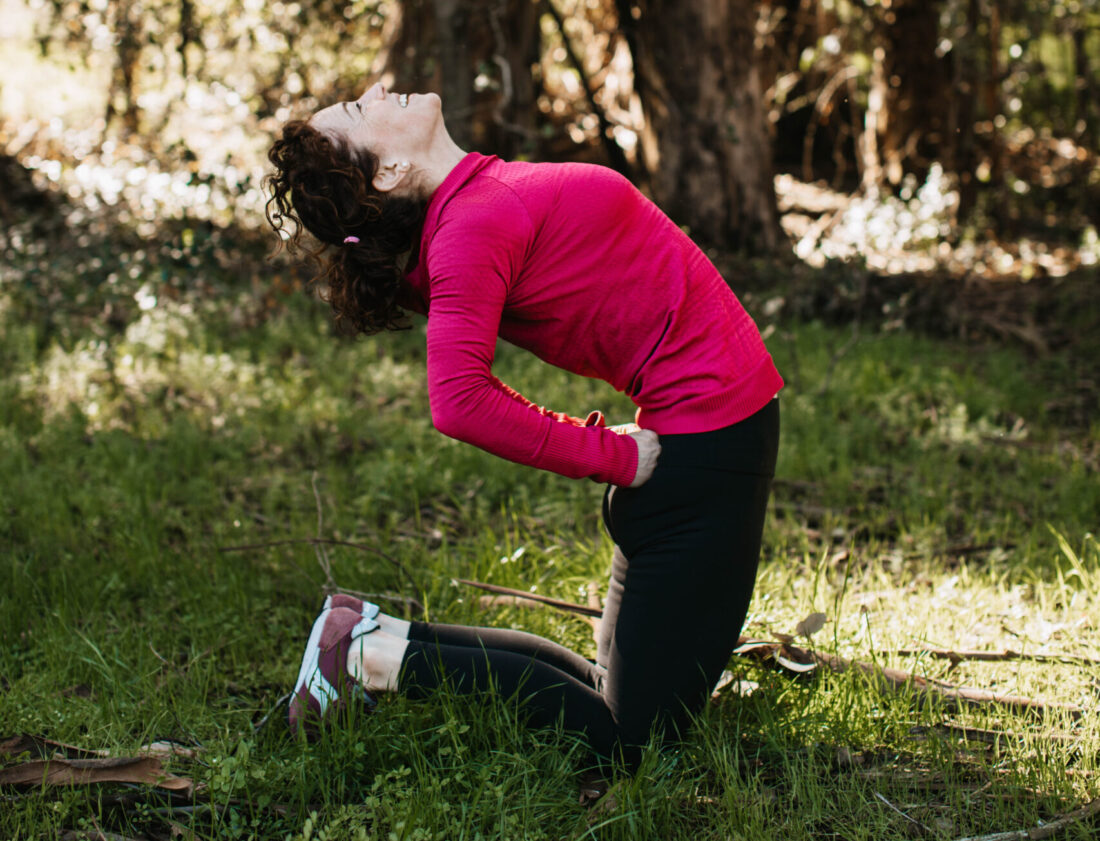
camel (Ustrasana) is a backbend that gets introduced in the second week of 40 Days to Personal Revolution…it’s an invigorating posture that opens up the front side of the body and strengthens the back, core and legs.

for some of us, it can also be a real pain in the neck…or low back….or the chest. but it doesn’t have to….

if you’re feeling pain in your neck, can’t swallow or get dizzy when you take camel: don’t drop your head back. imagine holding a pencil between your chin and your neck, your gaze will stay forward. you’ll still get all the benefits of the backbend, but you won’t crank your neck and dizziness will be prevented, since you’ll have better blood flow around the head and neck. the basic rule of thumb is that if you can’t swallow, bring your chin back in toward your neck.

if you’re feeling pain in your low back: make sure your tailbone is pointing straight down toward your mat and you’re pulling the front of your pelvis up by engaging your abdominals. keep your legs strong and make sure your thighs are vertical. if you still feel pain in the low back, you’re probably going to far, so let yourself come up a bit and really work to lift your chest/draw your thoracic spine in. you may need to come up on your toes, if your hands are on your ankles.


if you’re feeling tightness in the chest/can’t breath/feel like you’re going to suffocate: this is a totally normal reaction…camel is a pose that creates a powerful emotional release and can leave us feeling really vulnerable with the whole front side of the body exposed. you don’t want to suffer or panic in your practice, so only go as far into your pose as you can maintain ujjayi breathing. get comfortable with your camel and then begin to explore it a little more deeply each time you practice. just take it at a pace that works for you and over time, you’ll find that you might even actually enjoy the opening you receive.

one of the best guidelines i’ve heard about camel (and backbends in general), is that we want to receive more energy from the pose than we put into it. try noticing how much you’re putting into and getting out of camel and see what happens.

get present: child’s pose

Saturday, January 15th, 2011

as Week 1 of this Personal Revolution winds to a close, i went into the studio to prepare for tomorrow’s Week 2 kickoff…i cracked open the 40 Days book and workbook and folded myself down into a very familiar posture on my mat. it took me a moment to realize that i was starting my work by coming into child’s pose…i had to laugh at how completely appropriate it was.


child’s pose (balasana) is part of the Integration Series in our practice…it’s a powerful way of “presencing” ourselves in body and mind. we literally come down to our knees and down to earth…we get calm, come to center and connect with the floor beneath us, and this makes it a great place to start a vigorous yoga practice…and a great place to return when we need to recommit, redirect and reconnect. it’s different than just plopping down on the floor and taking a break; child’s pose aligns us with ourselves and prevents us from scattering our energy by looking all around the room.


to take child’s pose, you simply come to the hands and knees, sit the hips to the heels and bring the forehead to the floor. from here, there’s some personal choice in how wide to take your knees and whether or not to stretch your arms out in front of you…the wider you take your knees, the more you can drop down into the pose, so you might play with finding the right balance for you. if you’re really tight in your hips, you may want to roll up a blanket to place between your thighs and calves…if you’re really tight in the shoulders, you may like to place your arms alongside your legs.

regardless of the shape of your child’s pose, let it be an opportunity to create awareness of your breath and your body…take it when you need rest and restoration — it’s not sitting out, it’s a chance to go IN.